Reset or Rupture?
The Future of U.S.–South Africa Relations

America’s new Ambassador to South Africa, Leo Brent Bozell III, arrived in South Africa this week, prompting me to reflect about the fraught relationship between our two countries and where we should go from here. I don’t think things are broken beyond repair, but Bozell, along with President Trump, will determine whether we move further apart, or recalibrate towards pragmatic cooperation.
I’ve been thinking about our relations with South Africa since I first traveled there in 1991, the year after Nelson Mandela was released from prison.
At that time, Mandela’s ANC was still advocating for sanctions against the White government. Foreign governments and firms debated the merits of ethical and economic arguments for engagement.
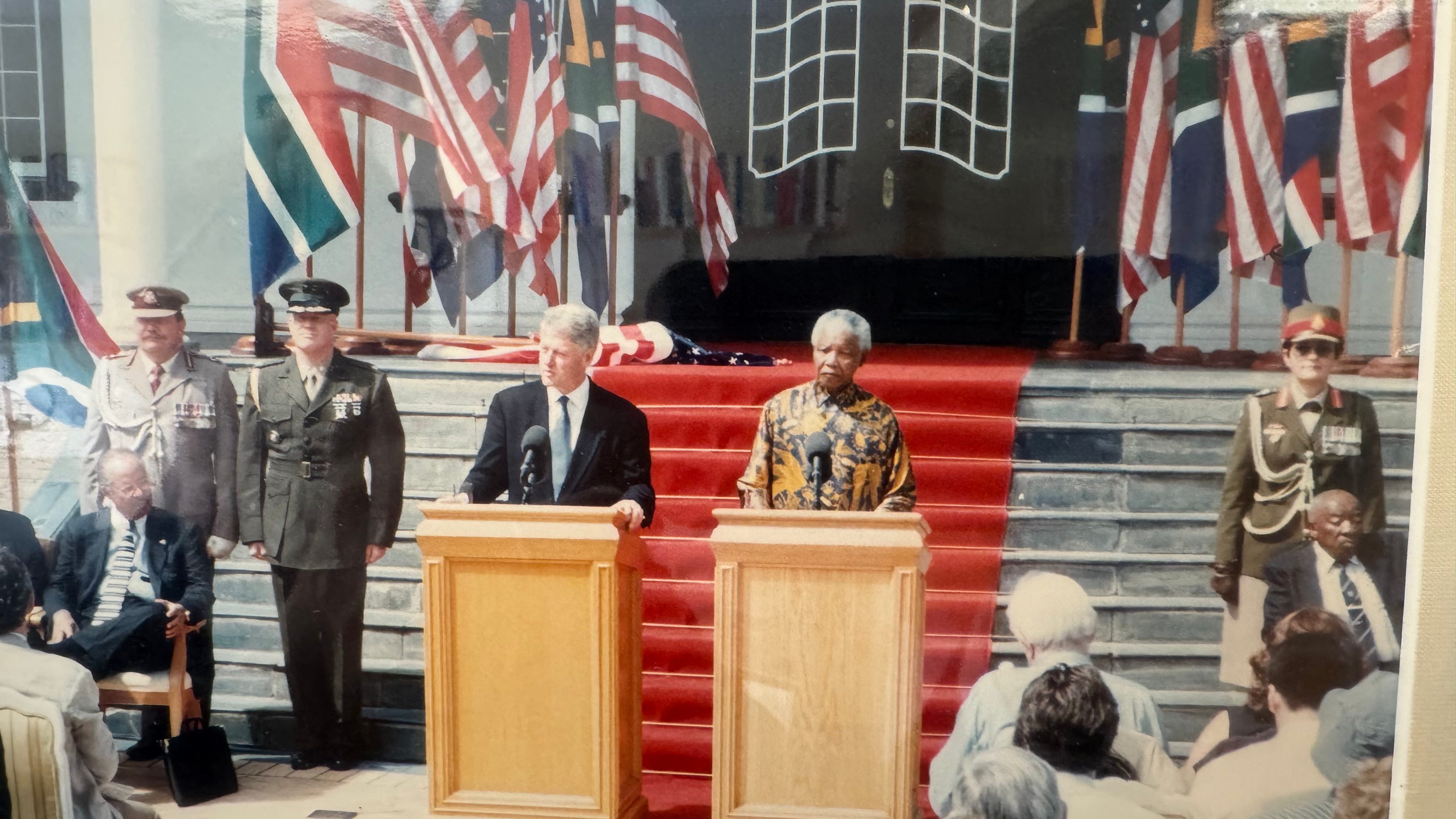
Of course, everything changed once Mandela became president. Americans and most of the world immediately and warmly embraced the country for its peaceful transition away from apartheid. South Africans became bullish on their future, anticipating an influx of trade and investment.
In March 1998, I got a back row seat, literally the last row, to a press conference featuring Bill Clinton and Nelson Mandela. They delivered their speeches with mutual admiration outside the South African president’s office in Cape Town. I was a Fulbright Fellow at the time and had been asked to accompany the White House press corps on the day of the speeches.
While the speeches celebrated a deepening friendship and there was an unmistakable buzz in the air, there were also clearly some unresolved tensions, largely born of the fact that the ANC and the U.S. government had been on different sides of the Cold War, and the U.S. had been noticeably late to support the anti-apartheid movement.
Mandela highlighted that he had already welcomed Cuban president Fidel Castro and Libya’s Muhammar Qaddafi to the country, laying bare a tangible misalignment. Nonetheless, he made clear that South Africa’s friendship with foes of the United States would not stand in the way of a dignified and productive relationship between the two countries, a point that Clinton tacitly accepted.
Bilateral relations have remained strong, but early American apprehensions about the friends the ANC was keeping have continued to surface. Biden’s ambassador to South Africa, Reuben Brigety, caused a row when he accused South Africa of providing weapons to Russia in its war with Ukraine. And in March 2024, two members of Congress advanced a bilateral bill chastising South Africa for its opposition to Israel and for its engagement with several American foes. The bill failed to pass, in line with the longstanding modus vivendi that has persisted to mutual benefit, but it was a harbinger of what was to come.
The US-South Africa relationship has soured notably under Trump.
Just over a year into his second term, President Trump has not missed an opportunity to demonstrate his animus towards South Africa, and in turn, the South Africans are increasingly looking elsewhere for international partnership.
Trump sharply and publicly criticized South African President, Cyril Ramaphosa, during his visit to the Oval Office in May of last year. He also sent South Africa’s ambassador to the US home, boycotted the Fall 2025 G20 hosted in Johannesburg, and said that South Africa would not be able to take its seat when the summit is held at Mar-a-Lago next year.
Trump went on to offer refugee status to Afrikaners amidst unsubstantiated claims of a white genocide. And despite reinstating some PEPFAR funding on a temporary basis, Trump has made sweeping cuts to South African foreign assistance.
All told, we are now at a 35-year nadir in US-South Africa relations.
And yet, even with some points of disagreement, there is a strong case for a reset.
First, in contrast to what both Trump and ANC opposition leaders have claimed, there is simply no white genocide in South Africa. And despite the relationship between the African National Congress and the South African Communist Party, South Africa is absolutely a free market, capitalist country. For several decades, the President himself has been a corporate heavyweight, including serving as the executive chairman of his own Shanduka Group and as an international advisory board member for companies such as Coca-Cola and Unilever.
Importantly, South Africa has a lot to offer the United States. It is a mid-sized, upper-middle-income country of around 63 million people, the most industrialized country on a continent that promises to house one quarter of the world’s population by 2050, and the world’s most youthful population at that. South Africa boasts Africa’s most sophisticated communications, travel, and banking infrastructure. It is one of the few robust democracies in the region. And, while we have other important African allies, including Kenya, Ghana, Morocco, and Botswana, none offer as advantageous a gateway to the rest of Africa.
South Africa has emerged as America’s largest trading partner in Africa, with two-way trade topping $26 billion in 2024. The country is a crucial maritime partner, home to seven major seaports, which also serve as gateways to inland Africa and stopping points en route to Asia and Oceania.
Moreover, South Africa holds a unique strategic position in the world order, the product of its remarkable history of overcoming white rule and developing a multi-racial democracy. The country carries outsized weight as negotiator and peace-keeper. It is a partner in the BRICS group, which in addition to China, Russia, and several recent additional partners, also includes regional democracies of Brazil and India. By strengthening ties with South Africa, the United States could gain some strategic advantage with a pivotal player in these still-emerging alliances.
South Africans also have much to gain from a strong relationship with the United States.
As a significant beneficiary of the African Growth and Opportunity Act (AGOA), South Africa has received preferential trade status through duty-free market access. Plus, Americans have been increasingly contributing to the South African economy via tourism, a leading sector. In 2024, Americans accounted for the largest proportion of overseas tourists to South Africa, with over 370,000 visiting the country that year.
South Africans have also benefited from American support in addressing their HIV and AIDS epidemic. By the end of the last century, Southern Africa was the epicenter for HIV infections. In response, in 2003, President George W. Bush introduced arguably the most successful development project ever endeavored by the American government – the President’s Emergency Plan for AIDS Relief (PEPFAR). In South Africa, sharply increased antiretroviral (ARV) treatment funded in large part by PEPFAR, has contributed to a 66% decrease in AIDS-related deaths since 2010. Americans should be extremely proud of this program, though it has been severely curtailed and undermined by the dismantling of the US Agency for International Development, with some models estimating over 500,000 additional AIDS-related deaths by 2028 and a loss in life-expectancy for persons living with HIV by 3.7 years.
The United States might have some real disagreements with South Africa, but President Trump must decide whether these are sufficiently troubling to jeopardize the development of a pragmatic and mutually-rewarding alliance.
America shares many values, and parallel and intertwined histories with South Africa. President Trump’s ambivalence about South Africa seems to be rooted in a preference against acknowledging the common injustices of institutionalized white supremacy, and the civil rights struggles that advanced multiracial democracy in both countries. But these are absolutely central to the stories of South Africa and the US alike, and along with a shared commitment to liberal democracy, they can serve as the glue to reinforce shared economic and strategic goals.
South Africa may not be an economic or military peer of the United States, but it is not powerless, and if we don’t take action to reset relations, it will pursue other avenues. With weaker ties, other countries, especially China, are already finding opportunities to increase their influence, including through development assistance.
By all accounts, Bozell – a prominent conservative activist who has shared President Trump’s critical view of the post-apartheid South African government – does not present as a likely healer, to say the least. And I am under no illusions that Ambassador Bozell, let alone Trump, will see or weigh the options as I do. But there is still a window of opportunity to reset an important relationship to the mutual benefit of both countries. I still hold out some hope that these two countries can re-find the common ground that was the basis for the pragmatic optimism of the mid-1990s.
I appreciate your analysis and optimism. I too, wish for close relations between the United States and South Africa. To repeat: there is no genocide against “whites” of whites farmers in SA
Evan, it's great to see your commentary here. I hope what you see as possible comes to pass. I share your sense of possibilty. But is your hope born of romance rather than pragmatism. The relationship with Trump is crumbling, and ambassadors do not wield the influence in their capitals that they did before this age of instant communication. While South Africa's relationship with China is growing stronger, and China is the rising world power, with the USA on a more questionable trajectory. For so many countries, international relations today is either a choice between China and the USA, or a difficult path of balancing the two. For South Africa, it's probably a mistake to think about relations with the USA in isolation from wider strategic positioning with the BRICS alliance, with China specifically, and with Mark Carney's middle powers.